Risk of Rain 2 is a good game—or at the least, I like it. Steam puts me at 128 hours played, but I know that’s not right. It’s an easy game to sink into for hours at a time, but it’s also an easy game to leave open. Every playthrough, whether it’s hard-fought, tooth and claw for just a few minutes or a god run that goes on for two or three hours ends the same way. It takes just seconds. Maybe I beat the final boss or obliterate at the shrine. Maybe I find myself shooting in one direction, only to get shotgunned from behind by an Elder Lemurian. One way or the other, I’m brought back to the title screen.
And that screen does something to me.

It’s hard to pin down at what point Risk of Rain 2 becomes otherworldly, but this screen captures that sense for me. There’s such a specific mix of pale, cell shaded color and contrast—of nature and structure—of what is ancient and technologically advanced. It’s present in all of the game’s environments. It’s nearly real, but the sense of scale seems off.
Chris Christodoulou’s work on Risk of Rain 2’s soundtrack serves to highlight this, in a way. Outside of certain boss fights, the game’s music seems almost defined by its lack of concern for what the player is doing. You might be fighting your way through hordes of enemies, and while there’s some intensity to the music (carried by the electric guitar and drums present through most tracks), the OST seems at its strongest when you can zone out and get lost in it.
From his album commentary, it seems like that’s something Christodoulou intended from the start:
We wanted the music to be more atmospheric and more moody, and instead of having this constant drive that was more prominent in [Risk of Rain 1’s] soundtrack, this time around it’d be more like the music of the place, and not of the events that are happening.
When there’s that lull in the combat, and you look out over an impossible horizon, your questions are met with synth pulses and prog rock melodies that echo back your same feelings—that this is a world once lived in. Now it’s home to the alien ghosts.
That’s the sense that I get, anyways, from Risk of Rain 2’s title track.
In the same way that the game’s music engages more directly with the world and atmosphere of Risk of Rain 2 than with the player’s actions, the core narrative is more concerned with pursuing a sense of wonder and discovery of a lost planet than it is with the details of that world or the characters that populate it. Petrichor V—the planet the game takes place on—is a world begging to be explored, but it is a world whose stories have already passed and whose answers are hidden away in hard to reach places. It is, by its own concession, a game whose stories mean less than the feeling the world imparts.
To be clear, if you dig around and pour over all the game’s hidden logs, you’ll get something out of it. But it’s incomplete, intentionally obscured, and mixed in with a lot of other stuff.
Some of the logs do seem to have a deeper narrative meaning.

Others paint a picture, but are mostly there for fun.
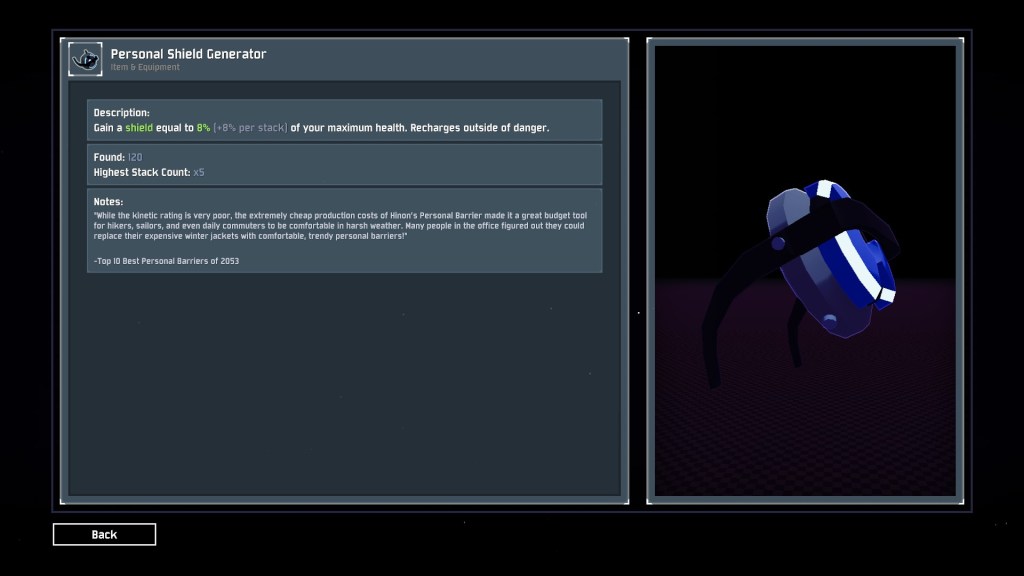
And some… Fill both roles. I guess.
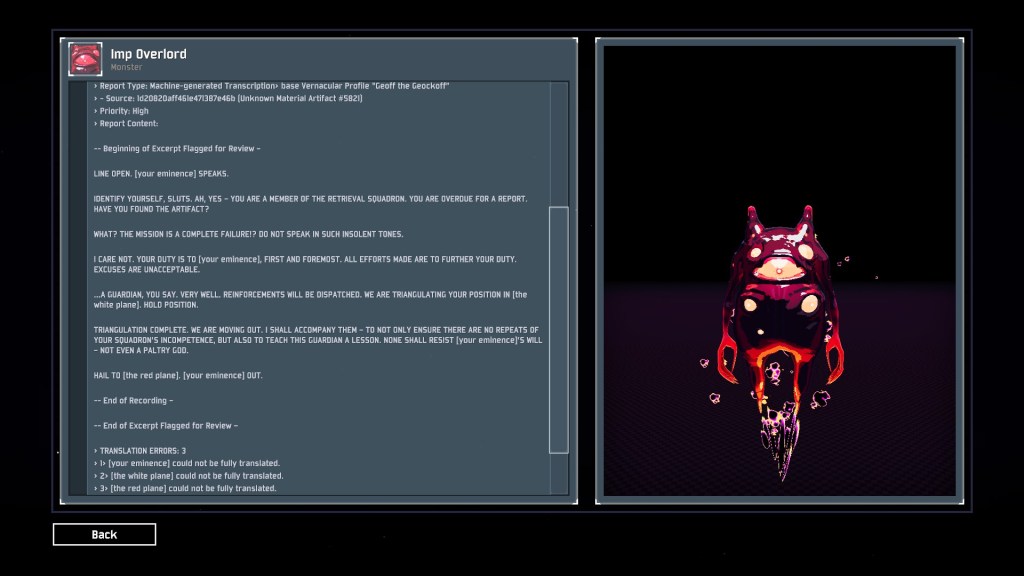
The main story told by these logs is a history of Providence and Mithrix, the bosses of Risk of Rain 1 & 2, the creators of life on Petrichor V, and, overall, petulant manchildren/siblings. Mithrix is generally the one in charge of designing their creations and Providence gives them shape. The two feud as Providence is attached to his creations and wont to give them soul, which Mithrix sees as a threat to their own safety. In short, a human vessel crash lands on the planet, and the survivors kill Providence before fleeing. Thus ends the first game. Now humanity has sent in a new crew to figure out exactly what the hell is going on and Mithrix ain’t havin’ it.
There are plenty of finer details that I could never describe succinctly, but this is already more than you need to know to enjoy the game for what it is.
I’m of the school of thought that engaging with narrative questions, including environmental storytelling, is gameplay. But opening a logbook from a game’s main menu to read is just that—reading. It might recontextualize what you see in the game while you’re playing, but it’s deliberately separate from everything else.
I don’t point this out to criticize the game. I think there’s a lot of promise to the game’s lore and writing, even if it’s sectioned off. But I do think it’s an interesting case study.
Whatever questions you have about the game, there are answers. But the game that you play knows what it wants to be.
Answers aren’t a part of that experience.
 Matthew Miller Stories
Leave a comment